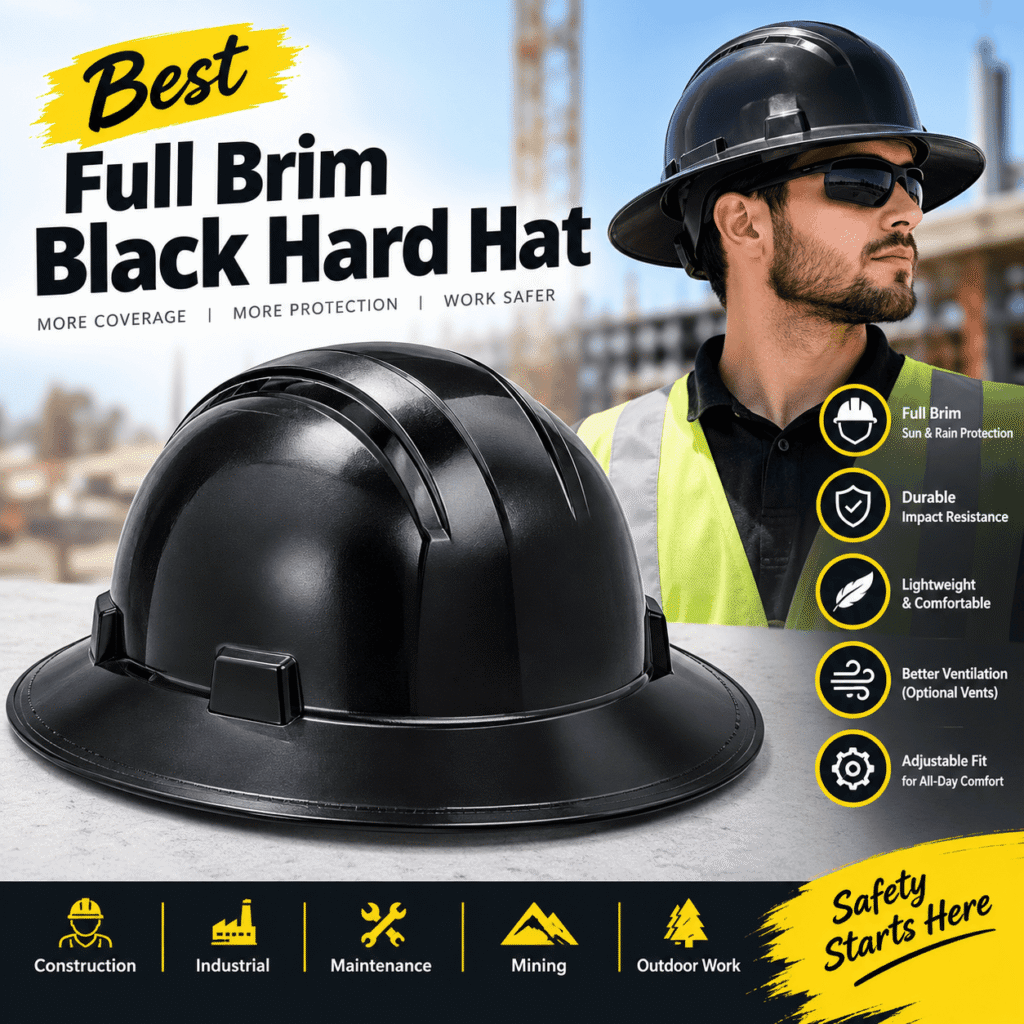
A full-brim black hard hat combines broad, 360-degree brim coverage with a professional black exterior commonly selected for construction, utilities, oil and gas, manufacturing, landscaping, inspection, and industrial maintenance work.
The full brim can help channel rain, dust, sunlight, and loose debris away from the worker’s face and neck, while the rigid shell and internal suspension are designed to reduce specified workplace head-injury hazards.
However, brim style and Colour do not determine the actual level of protection.
The safety performance of a hard hat depends on its marked ANSI or ANSI/ISEA Type, electrical Class, manufacturer-approved configuration, fit, condition, suspension system, and suitability for the hazards identified at the jobsite. A black full-brim shell may look rugged and professional, but buyers must examine the certification label and technical specifications before using it as occupational personal protective equipment.
OSHA’s construction head-protection standard requires protective helmets where employees may be exposed to head injuries from impact, falling or flying objects, electrical shock, or burns.
In general industry, employers must provide protective helmets where falling-object or electrical-conductor hazards could injure workers. Explains how to evaluate a full-brim black hard hat, understand important safety classifications, avoid misleading product claims, and select suitable industrial head protection for a specific work environment.
What Is a Full Brim Black Hard Hat?
A full brim black hard hat is industrial protective headwear with a brim extending around the entire shell rather than only across the front. The brim may provide practical environmental coverage while the shell, suspension, and optional retention components perform the protective functions for which the product has been tested.
The primary components usually include:
Outer shell: The rigid exterior designed to resist penetration and distribute impact energy according to the product’s tested standard.
Suspension system: The internal webbing, cradle, headband, or cushioning system that creates space between the head and shell.
Adjustment mechanism: Frequently a ratchet, pin-lock, or sliding adjustment used to secure the headwear.
Sweatband: A replaceable or integrated component intended to improve comfort and manage perspiration.
Full brim: The continuous edge surrounding the shell.
Accessory slots or mounting points: Manufacturer-designed locations for compatible face protection, hearing protection, lamps, or communication equipment.
Optional chin strap: A retention component that can help keep protective headwear in place during awkward movement, slips, or work at height.
A full brim should not be confused with lateral-impact protection. The brim is an exterior design feature, whereas an ANSI/ISEA Type II designation indicates that the headwear has been tested for impact protection involving the front, back, sides, and top. A full-brim product may be Type I or Type II, depending on its tested construction and markings.
Quick Comparison Table
| Feature | What It Means | Why It Matters |
| Full brim | Brim extends around the shell | Can help deflect rain, sunlight, dust, and minor falling debris away from the face and neck |
| Black shell | Dark exterior colour | Offers a uniform professional appearance but is generally less visible than bright or high-visibility colors |
| Type I | Tested primarily for impacts to the top of the head | Common for overhead falling-object hazards |
| Type II | Tested for top and lateral impact performance | May be appropriate where side, front, or rear impacts are reasonably foreseeable |
| Class G | General electrical protection; proof-tested at 2,200 volts | Intended to reduce exposure to lower-voltage conductors |
| Class E | Higher electrical protection; proof-tested at 20,000 volts | Often considered for electrical and utility hazards |
| Class C | No electrical protection | May include conductive or vented features and must not be treated as electrical head protection |
| Ratchet suspension | Adjustable dial-based fitting system | Allows fit adjustments while the hard hat is being worn |
| Vented shell | Openings designed for airflow | Can improve ventilation but is incompatible with Class E electrical claims |
| Non-vented shell | Shell without ventilation openings | Common in electrically rated configurations |
| Reverse-wearing mark | Manufacturer marking allowing approved backward use | Required before the hard hat should be worn in reverse |
| HV marking | High-visibility designation | Indicates testing and marking for enhanced visibility rather than merely a bright-looking colour |
OSHA’s safety bulletin recognizes two impact Types and three electrical Classes. Type I protects against blows to the top, while Type II addresses impacts to the top and sides. Class G is proof-tested at 2,200 volts, Class E at 20,000 volts, and Class C provides no intended electrical-contact protection. (OSHA). Why Workers Choose a Full Brim Design
Coverage Around the Head
The continuous brim may help redirect rainwater away from the face and collar. It can also create additional shade around the ears and neck compared with a cap-style hard hat that has only a front bill.
This design is frequently considered for:
1. Outdoor construction
2. Utility maintenance
3. Road and bridge work
4. Forestry and landscaping
5. Oilfield operations
6. Agricultural facilities
7. Surveying
8. Equipment inspection
9. Roofing
10. Industrial maintenance
The brim is not a substitute for safety glasses, chemical goggles, a face shield, sunscreen, hearing protection, or other hazard-specific personal protective equipment. Each item must be selected through the workplace hazard-assessment process.
Professional Black Appearance
Black hard hats are often chosen to support a uniform visual identity. Contractors may assign black head protection to supervisors, inspectors, visitors, equipment operators, or specific trades.
A company may also purchase black full-brim hard hats for:
1. Corporate branding
2. Custom logo printing
3. Employee identification
4. Crew differentiation
5. Promotional safety programs
6. Contractor onboarding kits
Color assignments are usually organisational practices rather than universal legal codes. Employers should communicate their own color-identification system and avoid assuming that a black hard hat represents the same role at every jobsite.
Environmental Protection
A full brim may improve comfort in rain, light snow, dust, or direct sunlight. Nevertheless, environmental coverage must not be confused with impact, penetration, or electrical performance.
Workers in hot climates should also consider that a dark exterior can become hot in direct sunlight. Suitable suspension spacing, sweat management, scheduled breaks, hydration policies, and manufacturer-approved cooling accessories may improve comfort. Altering the shell by drilling ventilation holes is unsafe because unauthorised modifications can compromise the tested configuration.
Compatibility with Workwear
Black can coordinate easily with reflective vests, dark uniforms, welding garments, utility clothing, or compaworkweard work wear. Yet visibility must remain part of the risk assessment.
OSHA’s head-protection bulletin explains that headwear carrying an HV marking has been designated for high-visibility performance. A black shell should not be presented as high-visibility headwear merely because reflective stickers have been added. (OSHA). OSHA Head-Protection Requirements
Construction Work
Under OSHA’s construction standard, employees must be protected with protective helmets when there is a possible danger of head injury from:
1. Impact
2. Falling objects
3. Flying objects
4. Electrical shock
5. Electrical burns
The employer must provide suitable head protection meeting one of the consensus standards identified in OSHA’s regulation or demonstrate that the product is at least as effective as compliant equipment. (OSHA) General Industry
For general industry, OSHA requires an employer to ensure that an affected employee wears a protective helmet in an area where falling objects could injure the head.
Head protection designed to reduce electrical-shock hazards is also required when an employee works near exposed electrical conductors that could contact the head. (OSHA) OSHA Does Not “Approve” Individual Hard Hats
Online listings frequently use phrases such as:
1. OSHA approved hard hat
2. ANSI certified hard hat
3. OSHA-certified safety helmet
4. ISEA certified PPE
These descriptions can be misleading.
OSHA establishes and enforces workplace-safety requirements, but buyers should not assume that OSHA has individually approved a commercial hard-hat model.
Similarly, ISEA warns that ANSI and ISEA do not manufacture, approve, test, or certify individual products. A responsible listing should identify the standard to which the manufacturer states the product conforms and provide the required markings or supporting documentation. (ISEA) product description would say:
“Manufacturer states that this head-protection product meets ANSI/ISEA Z89.1, Type I, Class E requirements.”
The label inside the hard hat and the manufacturer’s technical documentation should support that statement.
Understanding ANSI/ISEA Hard-Hat Types
The ANSI/ISEA Z89.1 framework divides industrial head protection into two primary impact Types.
Type I Head Protection
A Type I hard hat is designed and tested primarily for impact protection involving the top of the head.
Potential applications include workplaces where the principal risk comes from:
1. Dropped hand tools
2. Falling building materials
3. Overhead construction activity
4. Suspended objects
5. Materials falling from shelves or platforms
6. Contact with overhead structures
Many traditional full-brim hard hats are Type I products. This does not make them inferior; it means they were evaluated for a particular impact profile.
Type II Head Protection
Type II head protection includes performance criteria addressing impacts from the front, back, sides, and top. Under the ANSI/ISEA framework, Type II requirements include lateral impact-energy attenuation, off-center penetration resistance, and retention-relatedProtectionce. (ISEA) protection may be considered for environments involving:
1. Equipment movement
2. Confined spaces
3. Scaffolding
4. Work at height
5. Slips, trips, and falls
6. Structural obstacles
7. Climbing
8. Side-impact exposure
9. Work around vehicles or heavy machinery
OSHA’s safety bulletin recommends that employers consider Type II head protection with chin straps for construction sites presenting high risks of falling debris, equipment impacts, awkward positions, or slip-and-fall hazards. The bulletin is advisory and does not replace a site-specific hazard assessment. (OSHA) Full Brim Does Not Automatically Mean Type II
A common purchasing error is assuming that a wide brim provides tested side-impact protection.
The brim may help deflect environmental elements, but lateral impact performance depends on the full protective system, including:
1. Shell geometry
2. Energy-absorbing materials
3. Internal suspension
4. Padding
5. Retention system
6. Tested configuration
Always read the interior label. Never determine the Type by visual appearance alone.
Understanding Electrical Classes
Electrical Class is one of the most important considerations when purchasing a black full-brim hard hat.
| Electrical Class | General Meaning | Proof-Test Level | Typical Consideration |
| Class G | General electrical protection | 2,200 volts | General industry and lower-voltage exposure assessments |
| Class E | Higher electrical protection | 20,000 volts | Electrical, utility, power-distributenergised-workized-work environments |
| Class C | Conductive or no electrical protection | No electrical-protection rating | Workplaces without electrical-contact hazards |
The voltages in the table refer to standardized proof testing and should not be treated as a guarantee that a worker can safely contact an energized conductor. Electrical work requires comprehensive hazard controls, training, safe work practices, approach boundaries, insulation, and other appropriate personal protective equipment.
Class G Full Brim Hard Hat
A Class G model is designed to reduce exposure to lower-voltage conductors and is proof-tested at 2,200 volts. It may be suitable where the employer’s assessment identifies both impact hazards and limited electrical exposure.
Class E Full Brim Hard Hat
A Class E full-brim hard hat is designed for higher electrical-insulation performance and is proof-tested at 20,000 volts. This category is often searched by electricians, utility crews, linemen, electrical contractors, power-generation workers, and industrial maintenance teams.
A Class E shell should be non-vented. OSHA states that vented hard hats or safety helmets cannot be used for electrical work, and ISEA identifies a product claiming both Class E protection and ventilation as an impossible combination under the cited ANSI/ISEA standard. (OSHA) Class C Full Brim Hard Hat
Class C head protection provides no intended electrical insulation. Some Class C designs use ventilation openings or components selected for comfort rather than electrical resistance.
Class C may be suitable only when electrical-contact hazards are absent and the product provides the necessary impact protection for the identified work.
Never Select an Electrical Class by Job Title Alone
Not every electrician performs identical work, and not every construction worker faces the same exposure. The appropriate Class must be selected based on actual hazards, including:
1. Proximity to energized conductors
2. Voltage level
3. Possibility of head contact
4. Work positioning
5. Environmental conditions
6. Conductive tools or structures
7. Required accessories
8. Applicable company procedures
A competent safety professional should complete the hazard assessment rather than relying on an online marketplace recommendation.
Black Full Brim Hard Hat Features to Compare
Shell Material
Industrial hard-hat shells may be made from materials such as high-density polyethene or glass-reinforced nylon. Material choice can affect weight, flexibility, heat performance, durability, chemical resistance, appearance, and cost. (OSHA) Elect a shell solely because the listing uses terms such as “heavy duty” or “military grade.” These marketing phrases are less meaningful than an identifiable standard, Type, Class, manufacturer, model number, and technical data sheet.
Suspension Points
Common descriptions include four-point, six-point, and multi-point suspension systems. A higher point count does not automatically mean superior protection. The complete product must be evaluated as a tested system.
The suspension should:
1. Fit securely
2. Maintain appropriate shell clearance
3. Distribute pressure comfortably
4. Remain attached at all designated points
5. Show no signs of stretching, tearing, brittleness, or chemical damage
Replacement suspensions should be approved for the exact manufacturer and model.
Ratchet Versus Pin-Lock Adjustment
A ratchet suspension allows the wearer to tighten or loosen the headband with a dial. It is often preferred by workers who wear different seasonal liners or need to make adjustments while wearing gloves.
A pin-lock system can be lighter and economical, but it may require the hard hat to be removed for adjustment.
The correct option depends on:
1. Frequency of use
2. Glove use
3. Shift length
4. Budget
5. Shared versus individually issued equipment
6. Seasonal accessories
7. Need for rapid adjustment
Vented Versus Non-Vented
Vented hard hats can increase airflow in hot, non-electrical environments. Non-vented models are normally selected where the required electrical Class prohibits ventilation openings.
Do not drill, cut, melt, or punch ventilation holes into a non-vented shell. That modification would create an untested configuration and may weaken or compromise the product.
Sweatband and Moisture Management
A comfortable sweatband may reduce irritation during long shifts. Consider whether it is:
1. Removable
2. Washable
3. Replaceable
4. Moisture-wicking
5. Compatible with the suspension
6. Available as a manufacturer-approved replacement part
Cleaning should follow the manufacturer’s instructions. Harsh solvents and unapproved chemicals can damage components.
Accessory Compatibility
A full brim black hard hat may be used with compatible:
1. Earmuffs
2. Face shields
3. Welding shields
4. Safety goggles
5. Headlamps
6. Communication systems
7. Sun shades
8. Winter liners
9. Chin straps
10. Identification badges
OSHA recommends inspecting manufacturer-approved accessories and confirming that they are securely attached and functional. Accessories from unrelated manufacturers should not be assumed compatible merely because they physically fit. (OSHA) Chin Strap
A chin strap may be valuable for climbing, working at heights, bending, confined-space activity, emergency response, or tasks where the worker’s head position changes frequently.
OSHA recognizes chin straps as an effective method of helping keep head protection in place during awkward positioning, slips, or falls. (OSHA) the strap and attachment system approved for the particular product.
Reverse-Wearing Capability
A worker should not automatically turn a full-brim hard hat backward. OSHA’s bulletin states that only head protection carrying a reverse-wearing label or mark should be used in reverse. (OSHA) full-brim models, reverse wearing offers little practical advantage because the brim surrounds the entire shell. Nevertheless, the manufacturer’s instructions remain controlling.
How to Choose the Best Full Brim Black Hard Hat
Use the following numbered selection process.
Step 1: Complete a Workplace Hazard Assessment
Identify actual and reasonably foreseeable hazards, including:
1. Overhead falling objects
2. Flying fragments
3. Low structural clearances
4. Side impacts
5. Vehicle and equipment movement
6. Electrical conductors
7. Heat
8. Cold
9. Chemicals
10. Molten material
11. Work at height
12. Reduced visibility
13. Rain, snow, and UV exposure
OSHA emphasizes that employers should select head protection after assessing the job site and determining the most appropriate Type and features for the hazards present.
Step 2: Select Type I or Type II
Choose Type I where top-impact protection matches the identified exposure. Consider Type II where lateral impacts, falls, equipment strikes, or contact with surrounding structures are foreseeable.
Do not use the brim shape as a substitute for reading the Type marking.
Step 3: Select Class G, E, or C
For electrical work, determine whether Class G or Class E is required. Class C should be limited to environments where electrical insulation is not needed. Reject a product that claims to be both vented and Class E.
Step 4: Verify the Standard Marking
Inspect the product label for:
1. Manufacturer name
2. Model designation
3. Standard designation
4. Type
5. Electrical Class
6. Size or adjustment range
7. Date code or manufacturing information
8. Optional markings, such as reverse wearing, high visibility, high temperature, or low temperature
The label should be legible and untampered with.
Step 5: Confirm Fit
A properly fitted hard hat should sit securely without excessive pressure points. It should not slide freely when the worker bends or turns.
Check:
1. Headband adjustment range
2. Shell clearance
3. Suspension seating
4. Sweatband comfort
5. Eyewear interference
6. Hearing-protection compatibility
7. Stability during normal movement
8. Chin-strap fit, when used
Step 6: Verify the Seller
Purchase industrial PPE from an established manufacturer, authorized distributor, safety supplier, or reputable retailer capable of providing documentation.
ISEA advises buyers to know the applicable standard, examine the seller, watch for terminology errors, and request testing paperwork when claims appear questionable.
Step 7: Consider Job site Visibility
Black may match a corporate uniform, but it can be less noticeable in darkness, shadows, tunnels, warehouses, or nighttime road work.
Where visibility is critical, consider:
1. An HV-marked product
2. A brighter shell color
3. Manufacturer-approved reflective markings
4. High-visibility garments
5. Site lighting
6. Worker-positioning controls
Step 8: Calculate Total Ownership Cost
The lowest purchase price may not be the lowest long-term cost.
Consider:
1. Replacement suspension availability
2. Sweatband cost
3. Accessory compatibility
4. Replacement intervals
5. Shipping
6. Minimum order quantities
7. Logo-printing setup fees
8. Employee comfort
9. Product consistency
10. Documentation
11. Distributor support
For business buyers, a standardized model can simplify training, replacement-part inventory, inspections, and accessory procurement.
Buying Checklist
| Purchasing Question | Acceptable Evidence |
| What standard does the hard hat meet? | Interior label and manufacturer technical documentation |
| Is it Type I or Type II? | Permanent Type marking |
| Is it Class G, E, or C? | Permanent electrical-Class marking |
| Is the shell vented? | Visual confirmation and manufacturer specifications |
| Is a Class E product non-vented? | No ventilation openings and consistent technical documentation |
| Can it be worn backward? | Reverse-wearing symbol or manufacturer authorization |
| Are accessories compatible? | Model-specific manufacturer compatibility list |
| Does it fit the employee? | Individual fitting and movement check |
| Is the seller reputable? | Traceable business, product documentation, warranty, and responsive support |
| Is the product damaged? | Pre-use inspection of shell, suspension, labels, and attachments |
| Is the black color suitable for visibility conditions? | Jobsite visibility assessment |
| Does the employer have replacement records? | Purchase, inspection, incident, and retirement documentation |
Care, Inspection, and Replacement
A high-quality hard hat cannot provide its intended performance when it is damaged, modified, incorrectly assembled, or poorly maintained.
Pre-Use Inspection
Before each use, examine the shell for:
1. Cracks
2. Dents
3. Cuts
4. Gouges
5. Holes
6. Deformation
7. Chalky surfaces
8. Fading
9. Burn marks
10. Chemical damage
11. Brittleness
12. Unauthorized stickers or paint
13. Missing labels
Run your fingers across the shell to identify irregularities that may be difficult to see.
Inspect the suspension for:
1. Torn webbing
2. Stretched straps
3. Frayed stitching
4. Broken attachment points
5. Damaged ratchet components
6. Compressed padding
7. Worn sweatbands
8. Missing parts
9. Improper assembly
OSHA recommends inspecting both the shell and suspension, checking certification markings, confirming fit, and examining approved accessories. (OSHA) Cleaning
Use the cleaning method specified by the manufacturer. Mild soap and water are commonly recommended, followed by air drying.
Avoid:
1. Gasoline
2. Paint thinner
3. Industrial solvents
4. Abrasive cleaners
5. Unapproved disinfectants
6. Harsh chemicals
7. High-temperature drying
8. Unauthorized paint
A product that has been exposed to an unknown chemical should be evaluated according to manufacturer guidance.
Storage
Store head protection away from:
1. Direct sunlight
2. Vehicle dashboards
3. Extreme heat
4. Extreme cold
5. Chemical fumes
6. Heavy objects
7. Sharp tools
8. Contaminated equipment
OSHA specifically advises against storing protective headwear in a car or other area where direct sunlight and extreme temperatures may degrade it. (OSHA) Replacement After Impact
A hard hat or safety helmet that has sustained a significant impact should be removed from service even when no obvious crack is visible. Internal damage or loss of performance may not be visually apparent.
OSHA advises retiring head protection immediately after an impact or significant force because the equipment may not retain its intended effectiveness. (OSHA) Service Life
There is no single universal replacement date that applies to every shell, suspension, workplace, and manufacturer.
Service life can be affected by:
1. UV exposure
2. Temperature
3. Chemicals
4. Frequency of use
5. Storage
6. Impacts
7. Cleaning methods
8. Material
9. Manufacturer instructions
Follow the model-specific replacement guidance and document the purchase date, inspection history, incidents, component changes, and retirement date.
Common Buying Mistakes
Mistake 1: Purchasing by Color Alone
Black is a style choice, not a safety classification. Confirm Type, Class, standard marking, fit, and condition.
Mistake 2: Assuming Full Brim Means Side-Impact Protection
Only a Type II marking confirms the applicable lateral-impact testing. A full brim may still be Type I.
Mistake 3: Believing “OSHA Approved” Marketing
OSHA does not function as a retail product-approval badge. Evaluate the manufacturer’s conformity claims and labeling.
Mistake 4: Buying a Vented Class E Hard Hat
A product advertised as both vented and Class E presents a major credibility problem. Vents are incompatible with the cited Class E requirements.
Mistake 5: Installing Universal Accessories
An accessory that clips onto the shell is not necessarily approved for that model. Unapproved attachments can interfere with electrical, impact, penetration, or retention performance.
Mistake 6: Wearing a Damaged Hard Hat
Cracks, dents, chemical exposure, UV degradation, damaged suspension, or a prior impact may require immediate retirement.
Mistake 7: Adding Paint or Drilling Holes
Unauthorized painting, drilling, cutting, engraving, or reshaping can compromise the shell and invalidate the manufacturer’s tested configuration.
Mistake 8: Ignoring Visibility
A black shell can be difficult to see in low-light conditions. Visibility risks must be addressed separately through color selection, approved reflective features, lighting, garments, or HV-marked head protection.
Mistake 9: Sharing Without Readjustment
A shared hard hat must be inspected, cleaned appropriately, and adjusted for each worker. Individually assigned PPE generally supports more consistent fit and accountability.
Mistake 10: Using a Bump Cap as a Hard-Hat Substitute
Bump caps and industrial hard hats are distinct product categories with different performance standards and applications. A bump cap should not replace required industrial head protection.
Full Brim Hard Hat Versus Cap-Style Hard Hat
| Comparison Point | Full Brim Hard Hat | Cap-Style Hard Hat |
| Brim coverage | Surrounds the shell | Primarily covers the front |
| Rain management | Can direct water around the head | Front bill mainly shields the face |
| Sun coverage | Provides broader shade | Primarily shades the eyes and forehead |
| Working in tight areas | Brim may contact nearby surfaces | More compact profile |
| Accessory selection | Requires full-brim-compatible accessories | Often has broader accessory availability |
| Visual style | Traditional industrial, utility, and outdoor appearance | Common construction and manufacturing appearance |
| Impact Type | Can be Type I or Type II | Can be Type I or Type II |
| Electrical Class | Can be G, E, or C | Can be G, E, or C |
| Best choice | Determined by hazards and work conditions | Determined by hazards and work conditions |
Neither shape is universally superior. The correct choice is the model that meets the required standard, fits the worker, supports approved accessories, and addresses the hazards identified by the employer.
Custom Black Full Brim Hard Hats for Businesses
Organizations often order black full-brim hard hats with custom logos, department names, employee identification, or emergency information.
Before ordering in bulk, confirm:
1. The printing process is approved by the manufacturer
2. The decoration will not cover required labels or inspection areas
3. Ink, adhesive, or engraving methods will not damage the shell.
4. The hard hat remains identifiable by Type and Class.
5. Replacement suspensions are readily available.
6. Accessories are compatible with the selected model.
7. Sample units have been fitted by representative employees.
8. The black color meets the jobsite’s visibility policy.
9. Purchase records and distribution records will be retained.
10. Workers will receive use, care, inspection, and retirement training.
Businesses purchasing construction PPE should request a written quotation that separates:
1. Unit price
2. Logo setup
3. Printing charges
4. Additional logo locations
5. Shipping
6. Replacement parts
7. Accessories
8. Minimum quantities
9. Production lead time
10. Warranty terms
The purchase decision should prioritize verified protective performance over cosmetic customization.
Frequently Asked Questions
Q. Is a full brim black hard hat OSHA compliant?
A. A hard hat is not compliant merely because it is black or has a full brim. Its conformity depends on the product’s standard markings, Type, electrical Class, condition, configuration, and suitability for the identified workplace hazard.
OSHA’s construction and general-industry regulations identify head-protection requirements and recognized consensus standards. (OSHA) black hard hat hotter than a white hard hat?
A black surface generally absorbs more radiant heat than a lighter surface under comparable direct-sun conditions. Actual wearer comfort also depends on shell material, airflow, suspension spacing, humidity, workload, shade, and environmental temperature.
Workers in extreme heat should follow the employer’s heat-illness-prevention procedures and evaluate whether a dark shell is appropriate for prolonged outdoor exposure.
Q. What does a black hard hat mean?
A. There is no universal nationwide meaning. One employer may use black for supervisors, while another may issue black to all workers. The company’s written color policy determines its meaning at a specific workplace.
Q. Are full brim hard hats better?
A. They may provide broader rain and sunlight coverage, but they are not automatically safer than cap-style models. Compare tested Type, electrical Class, fit, accessories, visibility, condition, and hazard suitability.
Q. Is a full brim hard hat Type I or Type II?
A. It can be either. Read the permanent label rather than judging from the shape.
Q. Which hard-hat Class is best for electricians?
A. The answer depends on the electrical hazard assessment. Class E offers the higher electrical proof-test rating recognized in the ANSI/ISEA classification, while Class G is associated with lower-voltage protection. Class C provides no electrical protection. (OSHA) a Class E hard hat have vents?
No. OSHA states that vented hard hats and safety helmets cannot be used for electrical work, and ISEA identifies a vented Class E claim as inconsistent with ANSI/ISEA requirements. (OSHA) stickers be placed on a black hard hat?
Only use stickers or markings allowed by the manufacturer and employer. Adhesives can conceal cracks, damage, or required markings, and some chemical formulations may affect shell materials.
Q. Can a full brim hard hat be worn backward?
A. Only when the manufacturer provides a reverse-wearing mark or explicit authorization. (OSHA) should a hard hat be replaced?
Replace it after a significant impact, when damage or degradation appears, when components fail inspection, or according to the manufacturer’s service-life instructions.
Q. Can I use accessories from another brand?
A. Do not assume cross-brand compatibility. Use accessories approved for the exact hard-hat manufacturer and model.
Q. What size full brim hard hat should I buy?
A. Check the manufacturer’s adjustment range and complete an individual fit test. The hard hat should remain secure without creating excessive pressure or interfering with eyewear, hearing protection, or other PPE.
Q. Is a black hard hat considered high visibility?
A. Not ordinarily. Head protection carrying an HV marking has been designated for high-visibility performance. Black color alone does not qualify.
Final Selection Guidance
A full brim black hard hat can be a practical choice for outdoor construction, utility work, industrial maintenance, oil and gas operations, manufacturing, inspection, landscaping, and other demanding work environments. Its full brim may provide useful coverage from sunlight, rain, dust, and loose debris, while the black finish offers a consistent professional appearance.
The best full brim black hard hat is not necessarily the most expensive, lightest, widest, or most heavily advertised model. It is the correctly marked, properly fitted, undamaged, manufacturer-supported protective system that matches the hazards of the work being performed.
Safety Notice: This article provides general educational information and does not replace an employer’s hazard assessment, product instructions, qualified safety advice, OSHA regulations, state-plan requirements, or other applicable workplace rules.
A product-comparison, affiliate-review, or e-commerce category-page version can be developed from this article.
#FullBrimBlackHardHat #FullBrimHardHat #BlackHardHat #HardHat #SafetyHelmet #ConstructionSafety #WorkplaceSafety #JobsiteSafety #IndustrialSafety #SafetyFirst #HeadProtection #PPE #PersonalProtectiveEquipment #ConstructionGear #SafetyGear
Related Keywords: black full brim hard hat, ANSI hard hat, OSHA head protection, construction safety helmet, electrical hard hat, Class E hard hat, Type I hard hat, Type II safety helmet, industrial PPE, custom logo hard hats